
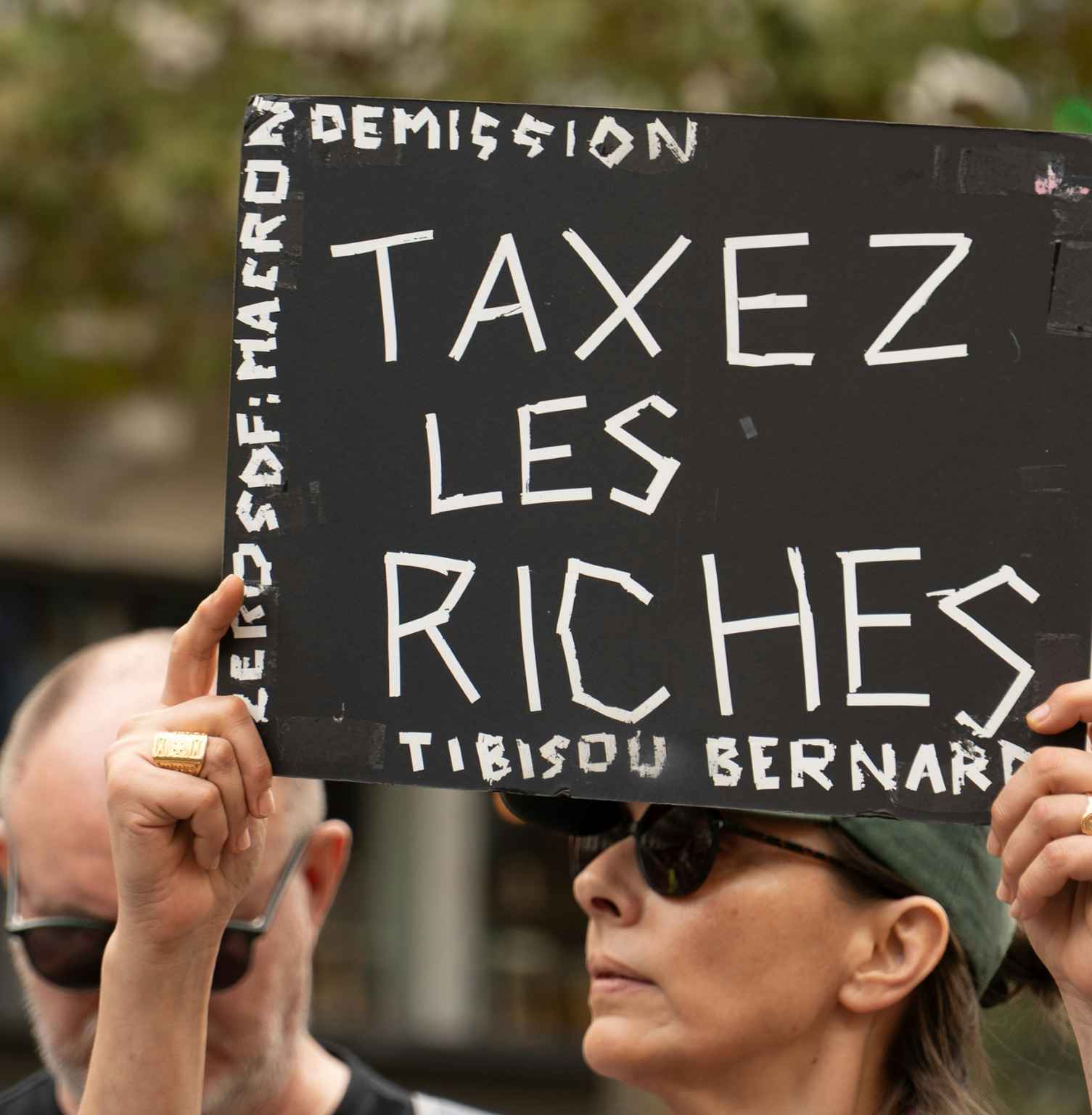
In recent years, French economist Gabriel Zucman has consistently argued that the super-rich should face at least the same effective tax burden as ordinary taxpayers. To achieve this, Zucman advocates a tax on net wealth (financial and non-financial assets minus debts) with a levy of up to 2 percent on households whose net worth exceeds €100 million. This so-called Zucman tax has rapidly gained international attention and support.
Yet despite its popularity, no EU member state besides Spain currently imposes a net wealth tax. For a region confronting mounting economic, social, and environmental challenges, European policymakers must recognise that these issues can only be addressed effectively and sustainably if the burden is shared fairly.
The richest can defer tax indefinitely
Discussions on net wealth taxes have gained traction globally, as demonstrated by the increased attention devoted to the topic within institutions such as the OECD, G20, UN, and European Commission. In Europe, this renewed interest can be explained by rising public concern about wealth inequality, the gradual erosion of taxes on wealth and wealth transfers over recent decades, and growing fiscal pressures in the aftermath of multiple crises.
Research shows that globally, the wealth of billionaires and centi-millionaires has grown at approximately 8 percent annually since the 1990s, nearly twice the rate of growth experienced by the bottom half of the population. Existing approaches to taxing wealth are therefore increasingly viewed as insufficient, which helps explain the growing support for net wealth taxes.
Broadly speaking, there are four ways to tax wealth:
- taxing income derived from assets, such as dividends, capital gains, and interest;
- taxing specific assets, for example through recurrent property taxes;
- taxing wealth transfers, such as inheritance and gift taxes; and
- taxing overall net wealth. The first three methods are widely applied across countries, whereas the fourth remains rare.
Each of the first three methods has significant shortcomings. In many cases, the tax base is narrow and can be reduced relatively easily. Inheritance taxes, for example, often apply only to a minority of estates, while recurrent property taxes in many OECD countries have failed to keep pace with rising property values.
Capital gains taxation presents an additional problem. In most countries, capital gains are taxed only once they are realised. This means only when the underlying assets are sold. Yet individuals with substantial wealth can often postpone such sales indefinitely. They may also use holding companies or other legal structures to minimise or entirely avoid capital gains taxation. Moreover, many of the wealthiest individuals simply retain their wealth within the companies that generated it.
At the same time, they can still access liquidity through loans secured against their assets and investments, or even through loans taken directly from their own companies. As a result, wealthy individuals are often able to enjoy the economic benefits of their wealth without triggering taxable events.
So, the current system distorts behaviour to such an extent that large capital gains often go effectively untaxed. Recognising this, it arguably makes more sense to tax the total net wealth of the very richest households directly.
The objections are manageable
Critics of net wealth taxes usually raise two practical objections. First, some assets - such as private businesses or artworks - can be difficult to value accurately. Second, a wealth tax could force individuals to sell assets in order to pay their tax liabilities.
Both concerns are manageable. Tax authorities already value illiquid assets for purposes such as inheritance taxation and financial reporting, while standardised valuation methods can further reduce complexity. Likewise, fears of forced asset sales are often exaggerated. Ultra-wealthy households generally possess diversified portfolios and substantial liquidity, while payment deferrals or instalment schemes can prevent disruptive sales when necessary.
A modest levy on extreme concentrations of wealth is therefore unlikely to create major economic distortions, especially when compared to the distortions produced by the current system, which allows large fortunes to accumulate and compound while often remaining lightly taxed for decades.
Ultimately, these are design challenges rather than fundamental objections to a net wealth tax.
It all starts with a feeling of fairness
A Zucman tax would be a logical first step for a region facing major challenges. The threat from Russia, the dependence on a less reliable US for defence and tech, the EU’s dependence on imported fossil fuels and critical minerals, all call for more autonomy. It is increasingly recognised that this autonomy can best be reached by accelerating sustainability transitions within the EU, as this will limit European dependency and strengthen Europe’s competitive edge.
For such a reform to succeed, the broadest possible support will be necessary. A higher tax burden for the wealthiest would contribute to this, by increasing a feeling of fairness. A survey across 17 G20 countries found that around 70 percent of adults support policies where the wealthiest pay a higher wealth tax, which in turn is used to fund green energy initiatives, universal healthcare and strengthening workers’ rights. Another global survey across 13 countries similarly found that nine out of ten people support taxing the super-rich to pay for public services and climate action. On an EU level, a recent survey found that nearly two-thirds of the Europeans back the introduction of a tax for the wealthiest 0.001 percent to ensure they pay a minimum level of taxes.
With a net wealth tax system, the wealthiest individuals could contribute back to the society that enabled them to accumulate such fortunes.
The tax revenues would be significant
Beyond questions of fairness, a wealth tax would also generate substantial additional tax revenue. In the EU, a Zucman tax would raise 67 billion euros annually and would neutralise the regressivity of the European tax systems. If you increase the Zucman threshold from 2 percent to 3 percent, €121 billion euros of taxes would be raised annually, thereby making the European tax system slightly progressive.
A more progressive wealth tax would generate even more: according to a recent study, an "aggressive" progressive wealth tax system applying to net wealth above €2 million, could generate annual revenues equivalent to 4.3 percent of EU GDP, provided that tax avoidance and capital flight are effectively curtailed. This would be more than sufficient to finance the EU’s annual green investment needs, while leaving 99 percent of EU households entirely unaffected. An additional advantage is that it would help to address the disproportionately large carbon footprint of the wealthiest households.
A net wealth tax could also help reduce the dependence of public finances on continuous economic growth. Unlike taxes on income or returns, a net wealth revenue base is less directly tied to economic expansion. As the economies of wealthy countries have grown more slowly in recent years and are expected to continue to lose pace, and as the negative environmental consequences of growth become increasingly apparent, a net wealth tax on the richest individuals could reduce some of the fiscal and distributive pressures that make contemporary economies dependent on continuous economic growth.
Extreme wealth inequality undermines political equality
Perhaps most importantly, however, a net wealth tax would address the democratic threat posed by extreme wealth concentration through growing political and economic power. Worldwide, a small group of billionaires now has significant interests in more than half of the largest media companies, and nine out of ten social media platforms are owned by just six billionaires. And even if it proved short-lived, Elon Musk’s appointment to head an American ministry illustrated how billionaire lobbying power can evolve into direct political power.
In the Netherlands, too, the influence of the richest is worrying: just 11 of the 500 richest individuals were responsible for 20 percent of all donations to political parties in the last election year. Nearly 90 percent of this went to centre right or right-wing parties, some of which are unashamedly pushing for the erosion of our democratic constitutional state.
Even if every citizen still holds one vote, these three interrelated channels of power (control over the media, political donations, and holding public office) give the wealthy an outsized influence over our politics. This goes against the very idea of a representative democracy.
Lesson from the past: prevent tax flight
Net wealth taxes are not a new idea. In 1990, 12 OECD countries, mostly European, applied some form of net wealth taxation. However, many of these countries abolished the tax in the 1990s and 2000s, largely because revenues remained modest and were seen as insufficient to justify the administrative complexity involved. The broader shift towards neoliberal economic policies during this period, with a stronger preference for lower taxation at the top, also contributed to its decline.
The limited effectiveness of wealth taxes in the past was partly driven by the ability of very wealthy individuals to relocate assets to more favourable tax jurisdictions. A key lesson from this experience is therefore that preventing tax-driven relocation is essential when implementing a net wealth tax. In this context, Zucman argues that individuals should remain tax-liable in their country of origin for 10 to 15 years after emigration, unless the destination country applies a comparable level of taxation. Such measures would make unilateral implementation of a wealth tax more feasible.
Today, Spain is the only EU country to levy a net wealth tax on individuals, raising around €2 billion in 2024, with little evidence of significant capital flight. Importantly, Spain does not apply the type of extended post-emigration tax liability proposed by Zucman. This suggests that unilateral implementation may already be more workable than critics often assume.
European governments should therefore stop waiting for perfect international coordination before taking action. Countries willing to move first could already introduce a net wealth tax, ideally combined with stronger anti-avoidance measures, such as exit taxes or temporary post-emigration tax liability for the ultra-wealthy. Even a small group of early adopters could be sufficient to trigger broader international coordination over time. An EU-wide wealth tax would likely be even more effective, but waiting for unanimous agreement risks turning political caution into permanent inaction.
Who will put a stop to the oligarchy?
The adverse consequences of today’s extreme wealth concentration are becoming increasingly difficult to ignore. Substantial reform of the tax system appears not merely desirable, but a prerequisite, both for successful sustainability transitions and for the long-term resilience of our democracies.
Roughly a century ago, wealth inequality in the United States reached similarly high levels to the ones observed today. At the time, the introduction of a highly progressive income tax played a key role in breaking the oligarchic concentration of power.
Today, the risk to Western democracies may even be larger: Elon Musk has surpassed John D. Rockefeller as the wealthiest individual in modern history. Moreover, whereas the wealthiest 0.001 percent of US citizens in earlier periods held wealth equivalent to roughly 4 percent of national income, today that figure is estimated to be closer to 12 percent.
This time, a progressive net wealth tax appears to be the only viable response. European governments should begin implementing it now, even if initially only at the national level and with a modest levy of up to 2 percent, as proposed by Zucman. The longer policymakers wait to confront extreme wealth concentration, the harder it will become to reverse its economic and political consequences.