

On the surface, the Dutch economy is in reasonable shape with low unemployment and rising purchasing power. Of course, the global turmoil is expected to affect the economic outlook, with higher inflation and lower consumer confidence, but standard economic indicators, including the relatively low government debt, stand out relatively favourably compared to other countries.
Yet, longer-term pressures are mounting also for the Netherlands. Climate change is becoming more urgent globally, biodiversity is declining rapidly, and international trade is under pressure. The Dutch economic model, built on cheap domestic fossil energy is becoming obsolete, and sustainability transitions are necessary.
Broad support, but rising polarisation
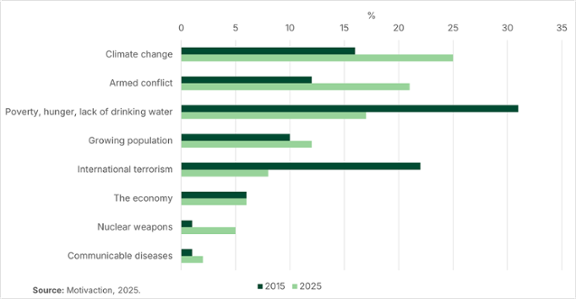
In the survey we asked respondents about their biggest concerns, which we compared with data from ten years ago. We then investigated their support for sustainability transitions, their views on (international) fairness, and how they prefer transitions to be organised. 25 per cent of the respondents named climate change as their biggest global concern, noticeably more than ten years ago. Although renewable energy generation is growing, global emissions from fossil fuels continue to rise. Globally, there is barely an energy transition yet.
Respondents take this problem seriously. A convincing majority sees climate change as a very serious problem, with a quarter of respondents seeing climate change as the biggest global problem (see figure 1). We see a similar pattern of increasing concern in attitudes towards global biodiversity loss.² Yet alongside this growing majority, a small but increasing minority dismisses these issues as non-problems, while the moderate middle is shrinking.
Figure 1: What is the most serious problem for the world?
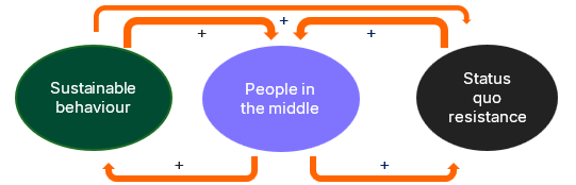
This pattern is not coincidental. It fits what transition theorists call regime resistance. Sustainability transitions are not politically neutral: they shift underlying values, threaten vested interests and impose both costs and gains. As more people adopt sustainable behaviour, partly because they observe it in their social circle, opposition can also harden among those who bear the costs or have vested interests in the current system.
Figure 2 illustrates this dynamic schematically.³ The key challenge for policymakers in navigating transitions is to ensure that the feedback loop toward sustainable behaviour wins out over the feedback loop toward status-quo resistance. By, for example, designing policy so that sustainable choices become convenient, more rewarding, and more “standard practice” over time, or by easing opposition to changes.
Figure 2: Transition dynamics with competing feedback loops
What counts as a fair transition?
A sense of fairness in transition could ease opposition to changes, weakening the feedback loop to status quo resistance. Therefore, we asked respondents what they consider a fair international distribution of ecological space. Four principles were presented, ordered from a large budget for the Netherlands to a small budget for the Netherlands:
- Equal percentage reductions from current levels for every country (so each country makes an equal proportional reduction effort).
- Equal environmental budget per world citizen (because every person is equal).
- Smaller budget for wealthier countries (because they have greater capacity to adapt).
- Smaller budget for countries with greater historical responsibility for environmental damage (because they have already caused more harm).
Dutch respondents showed a clear preference for equal distribution per person. This diverges significantly from how international agreements actually operate. Under the Paris accord, countries set reduction targets relative to their own historical emissions, and the EU’s framework largely follows this logic.
Under an equal-per-person principle, the EU would currently be falling short. For the Netherlands specifically, applying this principle would require around 20% more emission reductions by 2030 than currently planned. This gap between citizens’ intuitions about fairness and the actual design of climate agreements is worth taking seriously.

We suspect that respondents could not oversee the consequences of their choices here. However, this experiment is closely to the ‘veil of ignorance’ exercise of philosopher John Rawls: without knowing your own place in the sustainability distribution, you have to judge what a ‘fair’ place would be. We don’t expect that this fairness will be translated into (Dutch) politics. Voters know their positions, and when it becomes clear what their choice for fairness means for their particular situation, not all will vote for that.
How should the transition be organised?
Even with a specified ecological budget and expecting that this fairness exercise will translate into politics, we can distill from it multiple ways to organise a transition. We presented respondents with four stylised approaches that can help to steer the economy within planetary boundaries
- Smart technology: innovation so that the same level of welfare requires less environmental pressure.
- Steering sustainable choices: price incentives and subsidies so that consumers and businesses make greener decisions.
- Strict rules for everyone: setting environmental norms that apply equally to all citizens and businesses.
- Strong local communities: communities organising sustainability themselves at a local level.
We find that equal groups of citizens prefer smart technology, steering sustainable choices, and strict rules for everyone. Smart technology and steering sustainable choices also face relatively few opponents, which seems to imply these approaches are socially optimal. But a deeper look at the data tells a different story, one consistent with recent research.
‘Steering sustainable choices’ is particularly unpopular among people with vocational qualifications, who tend to have lower incomes. Within that group, ‘strict rules for everyone’ is clearly the most popular. While ‘steering sustainable choices’ is efficient in theory, its distributional effects are regressive. In practice higher-income groups tend to benefit from the subsidies while lower-income citizens bear disproportionate costs.
The result can be a political backlash that reverses the policy entirely. The 2018 gilets jaunes protests in France — triggered by a fuel tax that barely affected urban professionals but hit rural households hard — are a cautionary example. In order to organise an inclusive and smooth transition, policymakers would do well to take the preferences of such groups seriously, too.
Four policy levers for transitions with broad support
Combining survey responses and literature reviewed previously we can now draw conclusions about how policymakers might speed up sustainability transitions. These policy levers should not be used in separation, but need to be combined.
1. Communicate clearly about challenges and hopeful about the future
Awareness is a precondition for support: survey respondents who take sustainability problems seriously back transitions more consistently. Investing in broad awareness campaigns — via social media, education, and physical channels such as neighbourhood initiatives and public art — is therefore a direct investment in policy support.
But awareness of problems alone can be paralysing. Communication about challenges must be paired with an inspiring vision of what a region, country or the world would look like after the transition: think more free time, healthier lives, and lower energy bills. That appealing vision is also essential to win over people who are not primarily motivated by ecological concern.
2. Make it fair
The call for fairness is loud and clear in our survey. Transition policy that places costs disproportionately on vulnerable groups while higher incomes benefit from subsidies undermines itself. Justice must be a building block of successful transition policy, not an afterthought.
Fairness in transition policy has multiple dimensions. Procedurally, it means genuinely involving people from diverse parts of society in decision-making. Substantively, it means assessing who gains and who loses from each measure, and whether that distribution is defensible. Economic efficiency cannot be the only criterion in transitions; social acceptability must be weighed alongside it.
3. Make benefits tangible quickly
Transitions bring both costs and benefits. The political challenge is sequencing: make the gains felt before the costs bite. Home insulation is a clear example: it immediately lowers energy bills, a gain people feel regardless of their views on climate change. A large-scale insulation programme makes it easier for people to accept harder measures later on: carbon pricing, phasing gas out of residential heating entirely. Credibility should be earned early.
The same logic applies on the production side. Supporting workers from fossil-fuel companies into suitable new employment reduces resistance within that group, while innovation subsidies and transformation support can ease the transition for businesses. In both cases, the guiding principle is the same: ensure that the transition delivers tangible gains early on, for many people, rather than only imposing costs at the outset.
Transitions that feel like sacrifice from day one lose political ground fast. Those that start with a win have a fighting chance.
4. Use technology, but don’t expect magic
Smart technology enjoys strong public support. And rightly so: innovations such as solar panels, energy-efficient appliances, and circular materials deliver real environmental gains. Yet, when efficiency improves, the cost of consumption falls, and people tend to consume more as a result, offsetting some or all of the potential environmental benefits.
Electric vehicles illustrate the risk well. Battery costs are falling rapidly through innovation, making electric cars increasingly attractive. But the same trend is driving cars to become larger, heavier, and equipped with ever-bigger batteries, so that much of the efficiency gain is not converted into real sustainability gain.
It makes technology alone insufficient as a measure; we need policy to prevent those technical gains from being swallowed up by increased consumption. In the car example, setting a maximum battery capacity for passenger cars could prevent resources being used on unnecessarily large batteries for unnecessarily heavy vehicles. Innovation must be part of any transition, but relying on technology without providing regulatory direction is wishful thinking.
Learning, scaling and accelerating
The Netherlands faces major challenges that require economic transitions, as do most other countries. Our survey suggests that many Dutch people understand this and are often willing to make sacrifices, provided costs are shared fairly. At the same time, polarisation is a real risk: as sustainable behaviour spreads, so can organised resistance from those who experience the costs.
Policymakers need to keep both forces in view. Some transitions are gaining ground. The energy transition is picking up pace. But progress is uneven, and the gap between what is happening and what is needed remains large — in the Netherlands, in Europe, and globally.
The lessons are not complicated and can be applied beyond the Netherlands. Transitions need to feel fair. They need early wins. They need honest communication about what is at stake and a credible vision of what comes after. This survey confirms what transition research has long suggested: broad support exists, but it is fragile. It needs to be earned, and kept.
Learning, adapting, accelerating. That is the work.