

One of the delaying issues, Investor-State Dispute Settlement (ISDS), came through clearly in the scientific discussions. ISDS is a legal mechanism built into many trade and investment agreements. It allows foreign investors to challenge government decisions in international arbitration. In theory, ISDS protects investors against unfair treatment. In practice, it has often been used by fossil fuel companies to resist climate action.
How ISDS obstructs climate action
There are several real-life examples of energy companies bringing claims against governments over coal phase-outs, oil and gas restrictions, as well as changes to energy policy.
In 2022, Rockhopper Exploration brought a claim against Italy, after the country introduced a ban on new oil and gas projects within 12 nautical miles of its coast. Italy's measure was part of a broader effort to protect the environment, reduce the risk of earthquakes and limit offshore fossil fuel development. However, an arbitration tribunal ruled in favour of Rockhopper and awarded the company around €190 million in compensation. The decision was later annulled, which led to further arbitration; as of now the dispute is still ongoing.
In another example, RWE (a multinational energy company) filed a claim in 2021 seeking around €1.4 billion in compensation after the Dutch government passed a law to phase out coal-fired power generation by 2030. The policy is part of Dutch climate commitments and aims to reduce emissions in line with the Paris Agreement. Luckily, this particular case was discontinued.
Figure: The rise in ISDS fossil fuel cases between 1996 and 2023
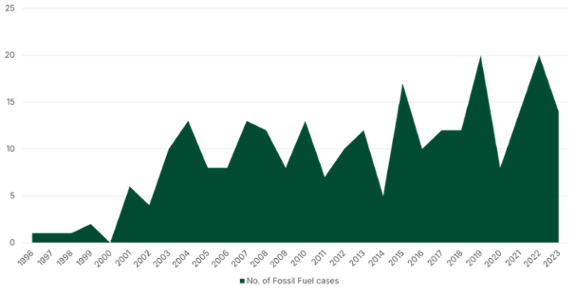
Both examples demonstrate how high the financial stakes are in ISDS cases. Even when governments win, the process to get there is long and costly. This can result in policymakers delaying, weakening or avoiding climate measures, for fear of being sued.
Santa Marta's take on ISDS
At Santa Marta, the academic community did not shy away from this reality. ISDS was identified as a structural barrier to climate progress. As policy advisor Lukas Schaugg pointed out, many climate and energy policymakers are still not fully aware of the risks ISDS creates. And if governments do not see the problem clearly, they are less likely to act on it.

So, did the conference’s final takeaways reflect this level of attention and the clear denouncement of ISDS? Unfortunately not.
In the wording of the final take-aways, ISDS appears only briefly and cautiously. It is mentioned alongside broader discussions on international financial and legal frameworks. The language suggests that ISDS is “perceived by some” as a barrier, and that views on its impact vary.
This softer framing creates distance between the strong scientific consensus presented during the conference and the final take-aways. And it leaves room for continued inaction.
An opportunity for investors to fill the gap
As long as we leave ISDS untouched, fossil fuel companies can continue to challenge the very policies that want to phase out their activities. This includes coal closures, oil and gas restrictions, and wider transition plans. In other words, one hand sets climate goals, while the other leaves open a channel to undermine them.
This matters for investors, because when companies try to block or weaken climate policy, it creates long-term financial risk due to the consequences of climate change. This is why it is essential that financial institutions oppose corporate lobbying that weakens effective climate policy, such as ISDS.
Investors should take a more outspoken position on this topic. Ideally, that would go beyond mere statements and translate into action, for example by integrating ISDS into exclusion criteria and engagement policies.
A practical step, already taken at Triodos Bank, is to exclude companies that are involved in:
- Corporate lobbying efforts that undermine effective climate policies;
- ISDS claims against governments, particularly where these claims target climate or energy transition policies.
Santa Marta put ISDS on the agenda and moved the conversation forward. The next step should be to close the gap between what we know and what we choose to do. Sustainable investors have a clear role to play in helping to close that gap.