


Ownership and governance are intimately connected. This makes a company’s ownership structure potentially crucial for the business strategy it pursues and the positive or negative impact it ultimately makes in the world. Though its current institutionalised form goes back to the 20th century, elements of employee ownership have been around for centuries, as an alternative to or partial modification of traditional shareholder ownership. The latter is currently the dominant form of corporate ownership and has been linked to aggravating social inequalities and ecological extraction. The previous article in this series discussed steward-ownership.
Types and characteristics of employee ownership
Companies can be employee-owned in different ways. To better understand the different types of ownership, we distinguish two key dimensions:

- Breadth: which portion of employees are owners? Only a small fraction (narrow ownership) or many/all (broad ownership)?
- Depth: how much control do employees have over the firm? Very little (shallow ownership; usually the case with minority ownership by employees) or a high level of control (deep (majority) ownership).
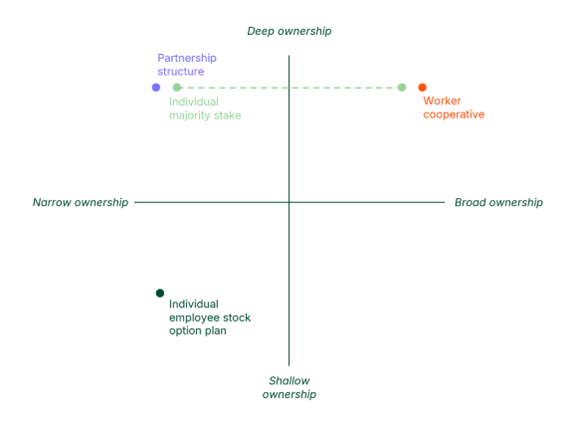
Figure 1: different types of employee ownership plotted based on level of control and breadth of ownership. Based on Mygind & Poulsen (2021).
The four types of employee ownership deliver very different levels of control with a very different distribution of power.
In individual majority stake ownership, employees collectively own more than half of the organisation. Control is generally deep, but the breadth varies – from one or two founders owning the organisation to all employees having at least a small stake in the organisation. Note that even when ownership is broad, voting power often reflects share size, so control is not equally distributed.
Partnerships are a specific subtype of individual majority stake ownership, where a small group of senior employees (narrow) has a high level of control (deep). Usually, these firms have very formalised arrangements regarding roles and decision-making processes.
Worker cooperatives combine broad and deep ownership: employees collectively own and run the organisation, typically following the ‘one member, one vote’ principle. They have high control over, for example, who sits on the board of the organisation. Workers cannot freely sell or transfer their stake in the company to others.
With employee stock option plans (ESOPs), ownership is commonly narrow and shallow, because 1) ESOPs generally exist in very large stock-listed companies of which employees only own a small portion of stocks and 2) usually not all employees are given (discounted) access to stock options.
These four categories are stylised typologies. In reality, hybrid forms exist. For example, in some startups, employees can also acquire stakes in a way that resembles both ESOPs (earning them over time) and individual majority stakes (larger influence and/or shared throughout the firm).
Cooperatives: not always employee-owned
Although cooperatives are often linked to employee ownership, not all are employee-owned. The ‘members’ of cooperatives can also be consumers (e.g. often seen with electricity or grocery store cooperatives), participants (e.g. collective ownership of solar panels) or individual producers (e.g. farmer cooperatives). This type of ‘community ownership’ will be the focus of the third article in this series, and we will therefore not discuss them at length here.
Why is employee ownership theoretically desirable?
Compared to traditional shareholder ownership, academic literature ascribes employee ownership with many (potential) benefits, which break apart into two categories.
Firstly, employees who are also owners presumably become better employees. The classic principal-agent problem (shareholders (principals) relies on oversight from the board of directors (agents) to safeguard their interests) is reduced. Employee ownership resolves the principal-agent problem because the agents essentially become the principals: the success of the firm is now truly their success. The result will be more committed, hard-working employees who are keener to invest in and follow through on potential innovations, develop themselves and each other, and step up when the business needs it. Employment relations are thought to become more stable too, with lower turnover rates.
Secondly, we can consider some normative arguments. Some scholars see greater worker-participation in firm decision-making as a tool to embed the political principle of democracy in our economic system. They view it as a matter of fundamental freedom, justice and equality to let workers participate in a company’s governance and (co)determine how they spend their time at work. Granting workers the right to control their workplace and to share in the profits would distribute power, income and eventually wealth.
Beyond enabling employees to better guard their own interests, more democratic organisations may also be better at balancing financial and non-financial goals (e.g. social or environmental impact). Theoretically, employee-owners care more about these impacts because 1) distributed ownership makes the ‘owner’ more representative of society at large, and thus more likely to consider broader societal values, and 2) employee-owners are more likely to be directly exposed to impacts in the local environment, business continuity, working conditions, etc. As a result, employee-owned organisations may place greater weight on social and environmental impacts, especially when ownership is broad and deep.
The broader role of employee ownership in capitalism is still disputed. Some see employee ownership as a way of making capitalist relations endure; by broadening the base of capital somewhat, tensions arising from the inequality of wealth accumulation and economic control are somewhat attenuated, thereby strengthening the hold of the current capitalist system.
Others see employee ownership as an avenue to transform capitalism into something different altogether. These authors refer to the deeper and broader forms of employee ownership. Distributing control throughout the organisation, can in theory lead to a more balanced set of objectives for the firm in addition to profitability. The extent to which these organisations really break free from capitalism ultimately depends on whether profit incentives are curtailed or deprioritised structurally. In the case of worker cooperatives, profit incentives are sometimes actively curtailed through asset locks (meaning profits are not or hardly distributed to members), which might lead members to prioritise social and environmental impacts further.
Interestingly, both tendencies exist within the spectrum of employee ownership: stock option plans and partnership structures as more archetypical ways of sustaining capitalism, worker cooperatives as a potential avenue for transforming it.
Prevalence of employee ownership
Because employee ownership takes many different forms, it is difficult to put an exact number on how many organisations are employee-owned exactly and how this number has developed over time.
Almost all large, listed firms in Europe have employee share-ownership plans. However, this ownership is usually both shallow and narrow. In fact, as the number of companies with employee share-ownership grew, ownership has become narrower on average.
However, there is also a significant number of deeply employee-owned companies in Europe, where employees own over 50 percent of the company. There are over 750 of these companies in Europe that are large (>100 employees), jointly employing about 750.000 people. While this segment has grown faster than the number of listed companies over the past two decades, it remains quite small in absolute terms.
In addition, there are many (often smaller) worker cooperatives in Europe. In the 21 EU countries represented by CECOP (the European association of cooperatives) there were around 31.000 worker cooperatives in 2023.
All in all, we can conclude that employee ownership is clearly a significant phenomenon across categories.
Financing employee-owned organisations
How employee-owned organisations can be financed markedly depends on their type. For most, financing works similar to that of more traditional shareholder-owned firms. Two cases stand out where financing is a different story:
Start-ups typically begin as fully founder-owned, with shares frequently offered to early employees too. Essentially these organisations are then majority-owned. They then often sell part of their equity stake to external investors to raise sufficient capital, grow, and hire more employees (who might not get shares anymore). Note that as they do so, employee ownership becomes more shallow (external investors gain more control) and more narrow (the portion of the employees that holds shares becomes smaller). As these businesses become more established, debt financing will also be available to them under normal conditions.
For worker cooperatives, financing is a different story. They can typically distribute profits to its members, and members can be liable for the obligations of the cooperative. Yet because control rests with members, cooperative cannot raise financing through emitting equity shares (which entail voting rights). Most cooperatives therefore raise risk-bearing capital directly from their members.
When a member leaves, their ‘share’ or membership is often bought back at par value by the cooperative. The limited access to external capital can constrain the development of worker cooperative, which is sometimes circumvented by issuing non-voting shares that give an entitlement to profit or similar instruments. Cooperatives can raise financing through debt like other organisations, depending on their creditworthiness in the eyes of financiers.
Employee ownership in practice
In practice, companies with deep and broad employee control tend to behave recognisably different from more shareholder-controlled companies.
Financial performance (especially productivity and survival rates) is somewhat higher for companies with broad and deep employee ownership. Apparently, the motivational effects on employees outweigh the effect of prioritising non-financial interests. These firms generally also show greater wage equality and more flexible pay.
Environmental outcomes are less clear. Broad employee ownership has been related to better environmental performance. While worker cooperatives in theory might also be expected to perform better environmentally, we are not aware of strong large-scale empirical evidence for this. Experiments do find that the managers of worker cooperatives are more risk-averse and altruistic than those in traditional companies, likely reflecting the preferences of their ‘principals’, which might well extend to more environmentally conscious behaviours.
With shallow and narrow employee-owned organisations, we see behaviour that is a lot like that of purely shareholder-owned organisations. Large, listed companies like DSM-Firmenich use employee ownership mainly to align incentives between investors and (top) executives, with limited levels of participation in the broader workforce. Partnerships, characterised by deep but narrow employee ownership, show some variation. Some partnerships, for example large consulting firms, are examples of ruthless profit maximisation with little fundamental value added. Others, such as smaller consulting firms, orient towards broader values more clearly.
Companies with broad and deep employee ownership, especially cooperatives, often stand out as companies with relatively equal pay and, at least sometimes, also more socially or environmentally oriented business practices. The most well-known group of cooperatives in the world might be Mondragon, the largest employer of the Basque country with over 70.000 employees in total.
However, Mondragon is sometimes criticised for a lack of full embodiment of cooperative principles, for example because not all its employees are part of the cooperative. An example of a cooperative that, to us, seems to embody the cooperative mindset to the fullest extent is Suma Wholefoods: a worker cooperative of nearly 200 people with complete wage equality, with a vegetarian and largely organic product offering, and employees rotating across various tasks.
Conclusions
Employee ownership means very different things to different people. On the one end: firms that give a few shares to top executives to align their interests with those of shareholders. On the other end: worker cooperatives that gives every employee an equal vote in business decisions and a share the risks and rewards.
Can employee ownership help us make our economy more sustainable? Evidence suggests that firms whose employee ownership is broader and deeper behave noticeably different from shareholder-oriented businesses. Employees become more committed to the organisation, employment relations become more long-lasting and so do companies themselves. We also find some evidence that suggests broad and deep employee ownership leads to business decisions that prioritise impact to a greater extent. We can thus conclude that the employee ownership can be a useful tool in furthering both the social and ecological transitions the world needs, primarily when ownership is broad and deep. For this reason, financiers (and governments) who want to further societal transitions would do well to stimulate this type of ownership.