
- Risks and uncertainty: Tensions between the US and Iran are resurfacing and we expect the Middle East conflict to muddle through in the second half of the year. Also clouding emerging markets’ outlook are the Fed’s rate policy and the US tariffs. Added to that are climate risks that increase many countries’ vulnerability.
- Diversification benefits: Commodity exporting emerging markets are defying expectations with relatively strong fiscal positions and high real policy rates compared to advanced economies, showing risk diversification advantages to investors.
- Patient capital wanted: Despite the increasing short-term capital flows to emerging markets in the past two quarters, patient, sustainable investments remain much needed.
Middle East risks
The reopening the Strait of Hormuz, now appears more difficult than it did at the start of the cease fire in April, making a continued muddling-through scenario, interrupted by occasional strikes, the most likely outcome. A memorandum of understanding (MoU) between the US and Iran signed in June has effectively broken down. Meanwhile, the hardliners have strengthened their position in Iran’s regime since the ceasefire, which makes negotiations even more challenging. But in the background diplomatic talks continue and new alliances are being built (Saudi Arabia, Turkey and Pakistan recently agreed a mutual defense pact), balancing the downside risks and maintaining relative stability in global financial markets.
GDP growth is slowing, particularly in the Middle East and emerging Asia, but domestically, credible exchange-rate adjustments and tighter monetary policy have helped limit economic instability. Additionally, since the Middle East conflict, commodity exporting emerging markets have benefitted from the rising commodity prices and strong currencies versus the US dollar.
Strong emerging markets currencies and high commodity prices
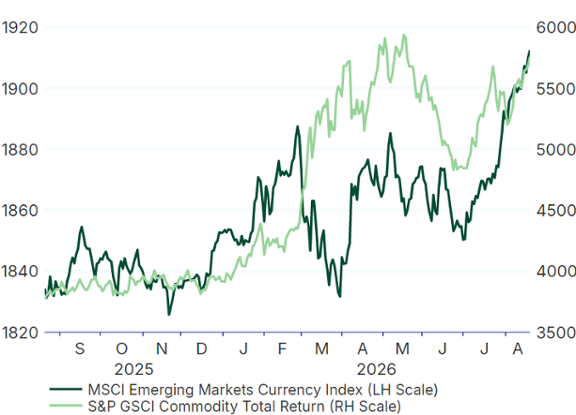
Net oil importers, particularly in emerging Asia, have been impacted by the Strait blockade. Energy supply shortages and blackouts have hit Pakistan and Bangladesh, but renewable energy is providing businesses and households an alternative. But also, in some cases, businesses have absorbed energy price increases. In countries with sufficient fiscal room, government subsidies also provided support.
Renewable energy on the rise – mitigating risks
We expect the closure of the Strait of Hormuz to continue to foster a positive environment for solar, wind turbines and battery storage in emerging markets.
China’s green-tech exports rose by more than a third in the first half of 2026, while domestic demand for electric cars also increased rapidly. Pakistan has also become a fast adopter of solar energy, with growth accelerating significantly over the past year after uptake began in 2020. The private sector, frequently encouraged through social media, leads this rapid adoption. The Philippines’ shift to renewable energy is more recent, but it has already doubled its Chinese solar panel imports so far in 2026.
In India, the deployment of solar panels has been somewhat slower led by government intervention and by limitations on accommodating on the grid. Indeed, India’s government list of approved manufacturers to basically support local production has slowed deployment. State guarantees for solar panel producers have helped reduce investment risks. Sizeable investments are needed. India will need to increase its battery storage capacity more than 27 fold to fulfill clean energy demand.
In Bangladesh, the smaller penetration of clean energy due to institutional constraints and limited funding for investments, is leading to emergency fossil fuel imports at prices which so far reached nearly three times the pre-conflict price levels.
We expect the Middle East conflict to muddle through in the second half of the year, with military attacks likely to resurface occasionally as tensions rise. This will lead to volatile oil prices, with levels likely lower than USD 100 per barrel, as oil markets continue to adapt. The general rule, however, is that the longer wars continue, the greater their economic consequences. The conflict is disrupting supply in oil, gas, industrial inputs, and fertilizers and is pushing up freight rates. Additionally, Europe’s rearmament drive is forcing countries in the region to make further cuts on development aid reducing funding to the most in need, while patient capital, including foreign investments, has dropped to the lowest level since 2005.
Fed’s communication and rate uncertainty cloud the outlook
The uncertainty around the Fed’s rate policy remains a risk for many emerging markets because of its impact on their borrowing costs and currency performance versus the US dollar. The recent uncertainty over the proposed changes in the Fed’s communication strategy adds to this risk, especially if it weakens the US central bank’s credibility while US inflation pressures persist. Although emerging market currencies, including the Colombian peso, have strengthened lately and short-term capital flows have improved, the uncertainty around US monetary policy puts focus on the capacity of other central banks to respond.

Some emerging market central banks, particularly in countries exporting commodities, including Colombia have sufficient international reserves to manage the uncertainty around the Fed’s policy. Many others, however, may need external funding, including from the IMF, to strengthen their buffers. Central bank credibility will again be tested. If, as we expect, the Fed postpones rate hikes until the second half of 2027 and the US economy continues to grow above trend, emerging markets should benefit from a favourable environment as they will not have to defend their currencies and also hike rates.
US tariff threats continue to feed uncertainty
US tariff announcements continue to weigh on the global trade outlook. The latest trade war with Canada, measures to target drones and robots on national security grounds, as well as tariffs on goods from 60 countries accused of allowing forced labour and on trade rerouted through third countries to reduce Chinese import duties confirm that US tariffs can escalate unexpectedly. Apart from Canada, retaliation from trade partners does not yet appear imminent, but China’s export controls on rare earths and critical minerals could be triggered at the global level automatically in November 2026, the deadline to renew China’s export controls after the temporary suspension. Given China’s dominance in mineral refining, where it controls around 90% of global capacity, these restrictions would pose a significant downside risk to sectors dependent on timely supplies, including renewable energy, defence and AI. Tariffs and supply-chain restrictions are therefore likely to remain a major source of uncertainty. We do not expect China’s tariff response in November to create a disorderly disruption of trade.
Climate risks
Climate change is leading to surging energy demand as air conditioners are increasingly used in countries with extreme temperatures. If we add El Niño’s record temperatures building up in India and China before its expected appearance towards the end of the year, this will have a large effect on electricity demand, supporting coal producers as power systems rely more heavily on thermal generation. Normally in China, when power demand is elevated, coal plant dispatch increases. In Latin America, drought caused by El Niño in the past has exposed the vulnerability of hydropower-dependent systems within and between countries, leading to blackouts and the use of costly back-up fossil fuels’ generated plants. The already delayed transition from fossil fuels to clean energy, particularly grids, is critical to mitigate growing damage in the future.
Overall, resilience prevails
Wars, uncertainty about the Fed rate path and US tariffs and large investment in AI have not dented emerging markets’ incoming short-term capital flows and governments are even issuing record amounts of bonds. Global shocks that once triggered sovereign defaults and sharp sell-offs across emerging markets have not occurred, improving investor confidence and triggering short-term capital flows to countries that appear resilient. Many emerging markets are showing that they can deal with uncertainty and that they can offer diversification gains to investors. Yet patient capital that supports sustainable development remains needed and global uncertainty is a strong limitation for these flows.