

- Resilient but debt-fueled growth: Advanced economies expanded despite the energy shock, driven by AI-related investment and household spending. However, the resilience is increasingly debt-dependent, with tech firms and governments borrowing heavily, risking higher long-term interest rates.
- Fragile balance: We expect the expansion to continue as we expect the Middle East conflict to muddle through without full-blown escalation. Broadening inflationary pressures and a further rise in interest rates could derail momentum.
- Central banks remain cautious: Although there is pressure on central banks to hike their policy interest rates, we expect both the Fed and BoE to say on hold. We do however expect a final rate hike from the ECB.
The risk of (heavy) economic damage has not disappeared. June’s memorandum of understanding between the US and Iran quickly broke down, attacks resumed, and Iran again claimed control of the Strait of Hormuz, prompting the US to reimpose its naval blockade. Since then, tanker traffic through the strait has remained limited. After briefly falling towards pre-war levels, oil prices are now hovering around an elevated USD 85-90 per barrel.

So far, however, the macroeconomic damage has been surprisingly modest. Recent GDP releases show that all major advanced economies expanded in the second quarter despite the energy supply shock. The available underlying factors are also encouraging: household consumption held up and business investment continued to grow, suggesting that the shock has slowed momentum less than feared and has certainly not derailed the expansion.
Households surprisingly resilient
Part of the resilience in business investment reflects the AI boom, mostly originating from US companies. But it is the resilience in household consumption that is more striking, given that higher energy prices have squeezed purchasing power. Households, especially in the US but to a certain extent also in the UK and Western Europe, appear to have absorbed part of the shock by saving less or at least by not increasing their savings. This behaviour has been supported by strong gains in household wealth over recent years as financial markets and house prices rose. Households may also have assumed that the inflation shock would prove temporary. Recent inflation data partly supports that view: despite the still-elevated oil prices, core inflation in July stood at 2.5% in both the US and the eurozone. This is still outside central banks’ comfort zones, but not enough to suggest a renewed inflation spiral.
Momentum has carried into summer
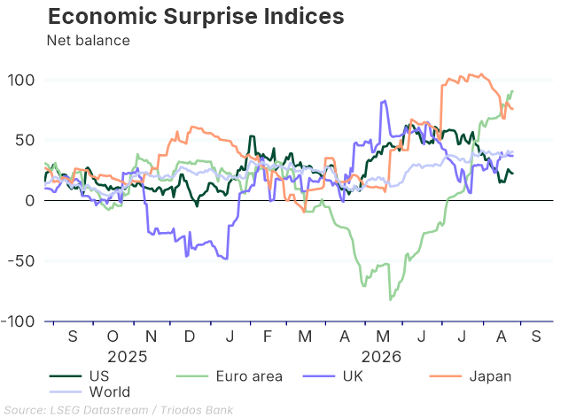
Recent business surveys (PMIs) suggest that this resilience carried into the summer. They indicate that growth accelerated in August across the major advanced economies. In general, global economic data continues to beat economists’ expectations, according to the Economic Surprise Indices. The eurozone had been the main exception, with disappointing data for several months, but that has turned around since July as the data flow improved.
There are some weak spots
Looking ahead, the key question is whether this resilience can persist without a credible resolution to the Middle East conflict. Some indicators are already casting doubt on the strength of advanced economies. July’s US labour market report was especially weak, showing that the economy lost jobs rather than adding them. Together with disappointing US retail sales, this suggests consumers may become less willing to draw down savings. At the same time, bond markets are coming under increasing pressure from large government spending plans, sizeable fiscal deficits and concerns that the conflict could keep inflation elevated. Higher long-term interest rates would add another burden for households and businesses as well as governments with high public debts. Tech-related listed companies could be particularly exposed if interest rates stay high for longer, as growth-stock valuations are generally more sensitive to rate movements. On top of that, the current AI investment boom is increasingly financed with debt, as major tech companies have already used much of their cash reserves. For 2026, investment-grade bond issuance by the largest tech companies alone is estimated to exceed USD 250 billion, which exceeds the issuance of any advanced economy besides the US. This means capital is becoming scarcer, which is also pushing up longer-term yields.
Our baseline remains a solid expansion, paid for by borrowing
Against this backdrop, our baseline remains that the expansion in advanced economies slowly continues, but on an important condition: the Middle East conflict does not escalate further. Our assumption is that the conflict muddles through for the rest of the year, without resolution but also without a full-blown escalation. In this scenario, oil prices are unlikely to move above USD 100 per barrel and could drift lower as supply chains continue to adapt. That would still leave the outlook fragile, but definitely not recessionary.
On that basis, the first pillar of support for economic growth is business investment. The AI boom remains a powerful engine, especially in the US. A recent estimate shows that global AI-related investment will likely exceed USD 1 trillion in 2026, equal to 0.9% of global GDP, and rise to 1.3% in 2027. An accompanied AI investment dashboard also points to robust near-term momentum for AI capital expenditure growth. AI spending should therefore continue to support growth, although higher rates and the growing use of debt finance make the cycle more vulnerable than before. Whether these huge investments will bring what many assume they will, remains to be seen.
The second support pillar is household consumption. If oil prices remain around the current level, further pressure on purchasing power should remain limited. In this regard, however, the outlook is more fragile. Consumption also depends heavily on labour market and asset price developments, and savings behaviour. US households’ equity exposure is close to record highs, so equity markets matter more than in the past for confidence and wealth. In that regard, second-quarter earnings were reassuring: large US tech firms again delivered strong profit growth, while other sectors posted their best post-pandemic earnings growth. This broadening earnings momentum makes the stock market less dependent on big tech and should support both investor sentiment and hiring. Recent European data also offer some support: according to the European Commission’s economic sentiment survey, employment expectations improved considerably in July, which should support consumption in the near term.
Central banks cautious, governments keep spending
The policy backdrop is also not uniformly negative. Softer US labour market and retail sales data, together with July’s relatively contained core inflation reading, make a near-term Federal Reserve rate hike unlikely. That should keep short-term US rates from rising further, while long-term rates remain vulnerable to fiscal concerns and inflation risk, and the limited guidance from the new Fed chair Kevin Warsh, which has made investors anxious. The ECB is likely to be less patient, given its stronger focus on current inflation pressures. We still expect one additional rate hike in September. By contrast, we do not expect the Bank of England to raise rates, as officials have shown greater willingness to look through the current inflation shock. Japan will likely stick to its gradual rate hike cycle.
Fiscal policy provides a final source of support. In Europe, the push for strategic autonomy is driving public investment in infrastructure, AI and defence. The US government is also showing no willingness to reduce its fiscal deficit, with the Middle East conflict adding pressure to increase defence spending. This should help sustain demand, although it also reinforces concerns about deficits and long-term interest rates.
Taken together, the outlook remains mildly positive, especially given the geopolitical backdrop. But the balance of risks is still tilted to the downside. A prolonged period of high energy prices would put renewed pressure on household purchasing power and could force central banks to tighten more than expected. It could also push both short- and long-term interest rates even higher, increasing the risk of a disrupted AI investment cycle that is becoming more dependent on debt financing. Expansive fiscal policy is helping sustain momentum, but could similarly come under pressure from further increases in interest rates.