
Despite these wars’ immense human toll and energy supply disruptions, the global economy has remained resilient: many countries have adjusted supply chains, trade has stayed robust and technology investment has helped absorb geopolitical disruptions. Yet prolonged hostilities are intensifying institutional weaknesses and social divisions worldwide, but more severely in the affected countries. This is making conflicts even more difficult to resolve.
This article examines the growing risk of conflict, the dynamics and drivers of the Middle East conflict and the fault lines that enable wars to persist. It urges governments, investors and multilateral institutions to recognise that today’s choices will shape tomorrow’s peace.
The macroeconomic costs of conflict
There are currently 65 active conflicts worldwide, most of them internal, alongside eight interstate conflicts between countries. That’s a record since World War II. Conflict, here, is defined as an ongoing, fluid struggle over arrangements of power, resources, and institutional legitimacy that result in at least 25 conflict-related deaths. Conflicts develop over time and therefore it is critical to understand why countries are drawn into conflict.

Conflict claims lives, disrupts societies and economies. At the macroeconomic level, the Middle East, for instance, is facing significant infrastructure destruction, an energy shock and a decline in employment. Conflict diverts resources from governments and companies towards a new reality focused on defence and has broader effects, including population displacement and increased uncertainty that is difficult to quantify.
More resilient conflict-affected countries can cushion disruption by drawing on financial buffers, adjusting supply chains, or securing temporary trade and financing arrangements with partners. Smaller countries may also benefit from ties with major powers. However, prolonged interstate conflict can deepen vulnerabilities even in the most resilient economies and more severely in poorer ones, making hostilities harder to end. Across conflict-affected countries, output losses can exceed those caused by financial crises and natural disasters and last for a decade.
Factors that drive and prolong conflicts
Today, competition for spheres of influence, power struggles among strong leaders, nationalism and security concerns are fuelling geopolitical instability, raising the risk of new conflicts and escalating existing wars. Less powerful countries are being pushed to align with states that share their political, economic and ideological values. New alliances for military collaboration are being formed, including the Joint Defence Agreement between Saudi Arabia, Turkey and Pakistan.

Conflict causes immense losses and deepens fragility, making resolution more difficult. Fragility can take the form of weak institutions, economic inequality, declining trust in government and limited capacity to provide security, uphold human rights and deliver public services. Its severity differs across countries, and the consequences depend on how quickly and effectively it is tackled, often with international support. Developments in the Middle East show why this matters: countries such as Iran face a long and difficult recovery, while the risk of spillovers to other countries in the region rises as the war continues.
The Fragile States Index identifies these vulnerabilities, helping direct reforms and investment to prevent further deterioration and prolonged conflict. Fragility is increasing in Iran, Russia and Ukraine, all of which were vulnerable before conflict began.
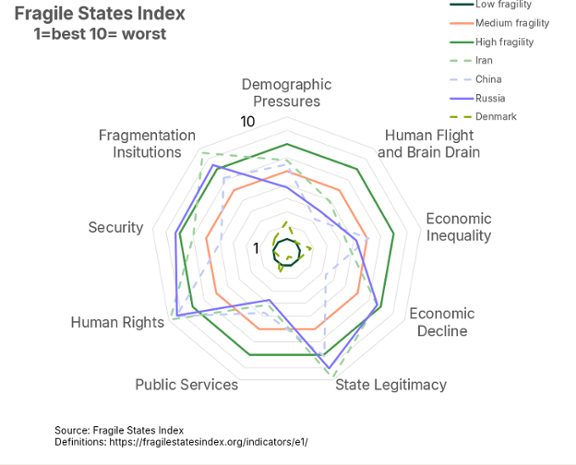
The key question is not whether a country is wealthy or powerful, but whether its institutions can manage competing interests, distribute resources fairly and maintain public trust. In wealthier countries facing rising fragility, investment choices therefore matter: those that deepen inequality can fuel populism and instability. For the most fragile low-income countries, timely international support, including development finance and aid, is essential to prevent and break cycles of conflict. In this context, cuts to development aid are unacceptable.
Where we stand in the Middle East conflict
A swift resolution to the Middle East conflict remains unlikely. The conflict is escalating, driven partly by attacks on energy infrastructure, supplies and exports, alongside extensive damage to civilian infrastructure. This is deepening fragility in the most affected countries and making a resolution more remote. At best, an exhaustion-driven de-escalation appears likely as war fatigue takes over, with the persistent risk of renewed hostilities.
The US administration’s “maximum pressure” campaign has further weakened Iran’s already fragile economy. The country is now in its second year of recession: output fell by double digits in the latest quarter, inflation exceeds 80%, and government revenues have declined by billions of dollars, losses that will be difficult to recoup in the near term. With increasingly little to lose, Iran continues to resist relinquishing control of the Strait of Hormuz.
At the same time, there seem to be limits on what the US Administration can do. The war against Iran has become deeply unpopular in the US, with voters’ views especially important ahead of the US midterm elections. The US House has voted to end the war on Iran approving a war powers resolution that would halt the US Administration’s ability to continue military action without congressional approval.
With underlying fragility unresolved and no clear vision for future development in the region as a whole, the prolonged conflict and uncertainty surrounding its outcome are creating a lose-lose situation and causing substantial harm across the Middle East. Bahrain, Iraq, Kuwait and Qatar are expected to record double-digit declines in output this year, while Saudi Arabia’s more diversified economy is likely to experience a mild recession.
As attacks and pauses alternate, the buffers that initially protected the global economy, based on expectations of a short conflict, are weakening, making the costs larger and more visible. Higher global inflation is eroding household purchasing power and prompting investors to reassess risk in the government bond markets of major economies with large budget deficits. The continuing conflict is also intensifying fragilities, including rising inequality and weakening social cohesion, which can fuel further conflict within and between countries.
Where we go next
Power struggles and growing fragility are increasing the risk of a long war in the Middle East. Further escalation is likely, with only short periods of calm as economic pressure and war fatigue grow. For now, a lasting pause remains unlikely. The impact will depend on how well each country in the region can redirect trade, keep production running and protect jobs. Iran and Iraq have limited capacity to deal with conflict-related disruptions. Saudi Arabia, the UAE and Oman are in a stronger position because they have healthier public finances and access to alterative ports.
Lasting economic and social stability requires more than military restraint. It also depends on stronger institutions, broader economic opportunities and sustained international support. In Iran, a more diverse, less oil-dependent economy could support wider civic participation and inclusion. Without these foundations, today’s pause could lead to renewed escalation. Governments, private investors and the financial community all have a role in the solution with the investment decisions that are made.
Possible scenarios for the Middle East conflict
The scenarios assume that the struggle for power prevails, indicating the most likely options lead to escalation, leaving war exhaustion as the main driver of periodic de-escalation (see figure from New Lines Institute below).
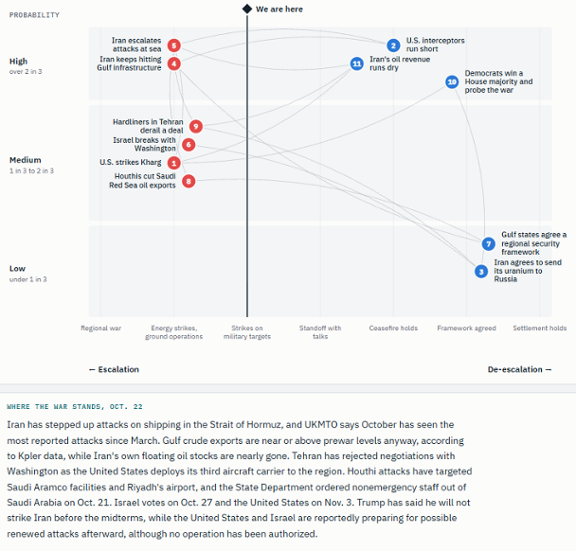
De-escalation:
Low probability: Uranium impasse resolved by transferring uranium to a third country (e.g. Russia).
Medium probability:
- War fatigue or exhaustion is the factor most likely to lead to some form of agreement. Iran is running out of money, while Washington is running short of interceptor aircraft and voter support. In September, the Pentagon estimated that the conflict had cost the US USD 43.6 billion, mainly for munitions and equipment that have not yet been replaced. US sanctions and the blockade of Iranian ports are also sharply limiting Iran’s oil exports and revenues. Without investment in its energy sector, Iran’s oil production will fall.
- A regional security framework based on economic cooperation between the Gulf states and Iran has been discussed many times but has not yet been created. Such a framework could help stop the cycle of growing fragility.
Escalation:
High probability: Iran’s failure to reach a nuclear deal leads it to keep attacking ships and infrastructure. Its aim is to pressure the international community to reconsider the US terms for a ceasefire.
Medium probability: Hardliners in Tehran and Israel, as well as armed groups such as the Houthis, become more involved in the fight for power. This could prolong the conflict and draw in more countries.