
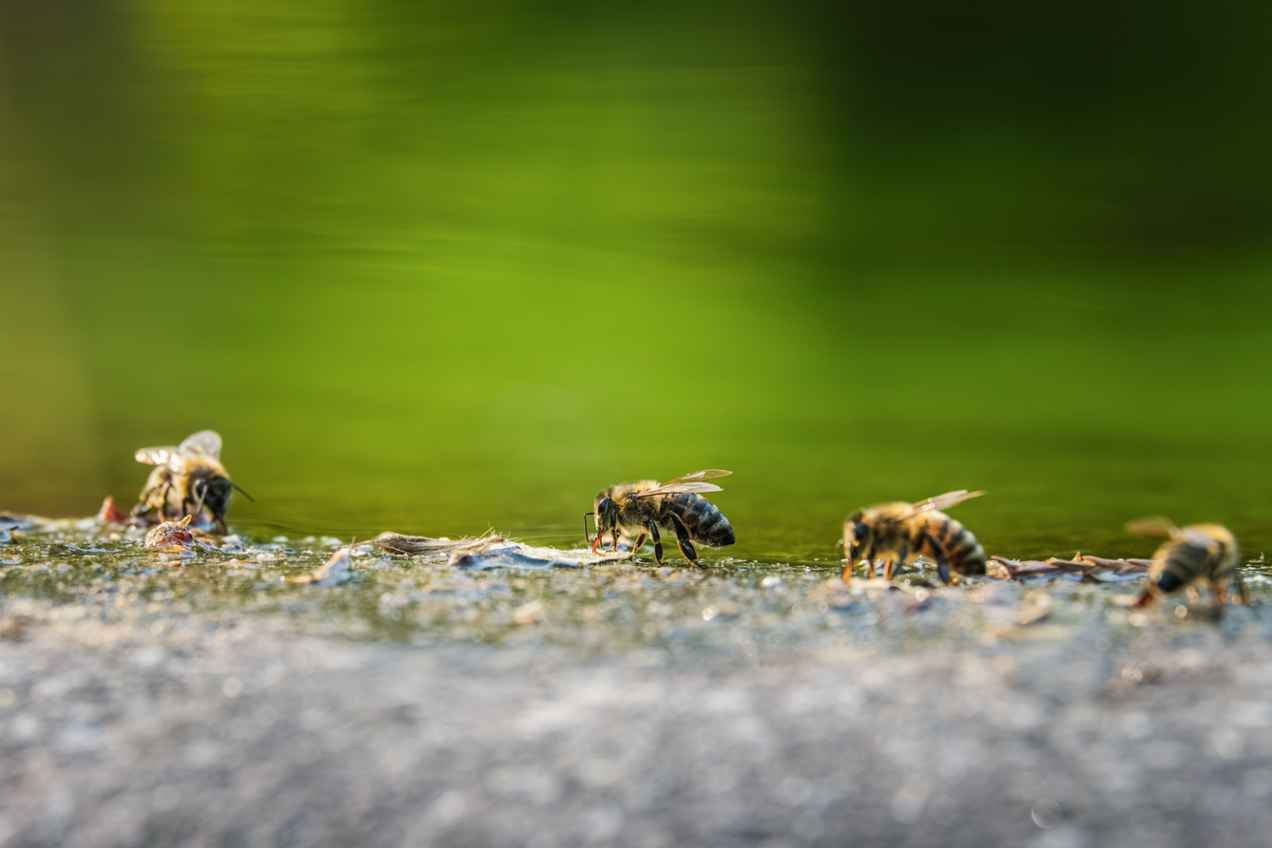
None of us could remember ever seeing bees outside at night or flying towards a light. Moths and mosquitoes, yes, but bees? After looking for advice on the internet, we laid spoons on the ground with water in them for the bees and we turned off the lights.

Later, I learned that heat can put bees under serious stress. Eggs and larvae stored deep in the nest can weaken or die from overheating, the queen’s fertility can drop, the wax of the nest can soften and melt, and heat can make bees more vulnerable to disease. In addition, bees may have less time and fewer resources to forage.
Heat-stressed bees have several cooling strategies: fanning their wings to draw cool air into the nest, collecting water and spreading it through the nest for evaporative cooling, and positioning themselves as living shields between the hot exterior and the vulnerable interior. Sometimes they evacuate and cluster outside in what is called a 'beard', which could explain why they were outside at night.
We noticed that there was a nest in the roof of our rental house. Insects like bees navigate by an overhead light source like the sun, or even the night sky. A light from below, like a lantern sitting beneath the nest, could have disoriented them and kept them from finding their way home. The light may also have disturbed the resting bees inside the nest.
Climate change needs attention as a driver of biodiversity loss
I am not sure what happened exactly, but reading about bees in distress during a heatwave likely worsened by climate change reminded me that climate change is one of the five main drivers of biodiversity loss. Some scientists expect it to overtake land-use change as the biggest driver this century. It is already causing more frequent and severe heatwaves, wildfires, droughts and storms. It is also redrawing habitats by shifting geographic ranges and seasonal patterns, leading to local extinctions and threatening ecosystem integrity. Preliminary studies forecast that even under intermediate climate scenarios, between 3 and 6 million animal and plant species could be lost in the next roughly fifty years.
The fossil industry harms biodiversity in different ways
Phasing out fossil fuels is critical to avoid pushing the climate beyond liveable limits for both humans and ecosystems alike, since about 68% of global greenhouse gas emissions come from fossil fuels. Still, climate change is not the only reason why scientists and nature organisations have called for the urgent transformation of our energy system away from fossil fuels to prevent a mass extinction event. For example, fossil fuel infrastructure development can destroy and fragment wildlife habitats and generate air, water, noise and light pollution. Fossil fuel infrastructure may also cause oil spills, with long-term negative impacts on ecosystems.
Similarly, many synthetic compounds, including pesticides and plastics, originate in the petrochemical industry. Pesticides such as neonicotinoids, for example, can affect species beyond their intended targets, harming bees, birds and aquatic animals. Plastics create an additional layer of harm: an estimated 19–23 million metric tonnes, about 2.5–3 kg of plastic per person on Earth, enters rivers, lakes and oceans each year, harming animals through ingestion, entanglement, toxicity and the spread of pathogens, while similar risks exist on land.
Phasing out fossil finance is a crucial part of stopping biodiversity loss
Unfortunately, fossil fuel financing by banks is increasing. Last year, the world’s 65 largest banks, many of which have nature strategies, financed $906 billion in fossil fuel companies. Of that amount, $508 billion went to companies expanding fossil fuel development, such as by building new oil rigs. This kind of financing locks in fossil infrastructure, making important long-term transitions in, for example, food and energy systems harder.
Renewable energy can also affect biodiversity, especially when large-scale solar or wind farms are built in sensitive areas. But these risks can be mitigated by building biodiversity measures into renewable energy projects, and distributed systems such as rooftop solar, storage and microgrids can reduce pressure on ecosystems while strengthening resilience. Beyond changing how we produce energy, we also need to use less of it.
After seeing and reading about bees responding to heat stress, I am convinced of this: tackling biodiversity loss is inseparable from addressing the fossil economy that is heating the planet and degrading ecosystems. Credible biodiversity finance strategies, by both governments and financial institutions, need to include a clear path for fossil phase-out. Otherwise, they are not credible.
As sustainability researcher at Triodos Bank, Pjotr Tjallema works on strengthening the connection between financial flows and real-world impact. He focuses on the food system, nature and biodiversity.