
- Europe’s extreme summer heat is already imposing substantial human and economic costs, including elevated heat-related mortality, pressure on healthcare systems and severe wildfire damage.
- The main ways in which heat affects EU GDP are lower agricultural output and higher food prices, constrained energy production and higher electricity prices, transport disruption and increased transportation costs, and reduced labour productivity. The total EU-wide GDP impact in 2026 is estimated at around -1%.
- Labour productivity likely has the largest economic impact, especially in heat-exposed sectors and countries with limited acclimatisation or low air-conditioning penetration.
- The impact differs strongly by country: France appears most impacted economically followed by Italy and Spain. The Netherlands also sees annual growth largely erased, while Poland is less affected because it experiences fewer extremely hot days.
- Adaptation can reduce some damage but cannot eliminate it; stronger mitigation and demand-side climate policies are needed to avoid a worsening cycle of heat damage and weakened climate action.
The fact that climate change affects long-term economic growth is by now an established consensus in science. Sea-level rise, lower crop yields, reduced dairy production, increasingly less fresh water availability, human health, reduced productivity and rising energy demand are main ways in which climate change hurts the economy. Over time, these diverse channels can add up to substantially lower growth, or even uncontrolled collapse: one recent estimate puts the long-run loss in world GDP at over 20% for every degree of global warming, once the full range of climate variability is priced in.1 Uncertainty here remains high, though. These estimates are modelled, and models rest on many assumptions.
But this summer in Europe we are witnessing something different: extreme heat for a prolonged period of time. This extreme heat across Europe, a direct product of climate change, has human and economic impact. While weather anomalies in the past have also had real economic consequences, we would be wise to interpret this extreme heat as more than an anomaly. What we see this summer might become structural given global warming, and next year might be even worse given the coming El Nino. Without adaptation to climate change and mitigation of carbon emissions, future climate costs might well become much higher.
Weather and society
Extreme heat affects the economy in several distinct ways: direct human effects, damage to ecosystems, the direct costs of responding to and repairing heat damage, and, cutting across all of these, lower production and GDP.
The most direct way is human health. Modelled and official counts both point to a heavy toll, with an estimated 20,400 heat-related deaths across France, Germany, Spain and Italy during the 22–28 June heatwave alone. National figures are broadly in line with that. Beyond mortality, heat also raises rates of suicide, domestic violence and acute kidney injury, effects that essentially never appear in economic figures but clearly imply a huge loss in wellbeing.
The effects on people are unequal: across 32 European countries, regions with greater deprivation, poorer housing and more energy poverty show substantially higher heat-mortality risk than wealthier regions facing the same temperatures. Richer, more urbanised areas are themselves not exempt, their heat vulnerability tends to be higher too, likely reflecting the urban heat-island effect. Older adults living alone or in poorly insulated homes carry a disproportionate share of the burden.
Heat and drought have also fed one of the worst European wildfire seasons on record. EFFIS, the EU's Copernicus-based monitoring system, had recorded 434,976 hectares burned across the EU by 30 July, already more than in the worst year up till now, with most hectares burned in Spain, Italy and France. The season is far from over, so this total will very likely keep rising. The toll is measured not only in trees lost and people forced to flee. The fires have scorched tens of thousands of hectares of forest, grassland and farmland across Europe, destroying habitats for deer, wild boar, foxes, rabbits, birds, reptiles, amphibians and countless insects.
Extreme heat also creates direct public costs that would not otherwise occur, including wildfire response and increased pressure on healthcare systems. The European Parliament approved €120.55 million from the EU Solidarity Fund to help Spain recover from the devastating 2025 wildfire season, while the broader economic costs of Europe's 2026 wildfires are already estimated in the billions of euros. During the Netherlands' first-ever Code Red for extreme heat, the KNMI reported that ambulance services came under severe pressure, hospital admission capacity was limited, and emergency departments experienced unusually high demand from patients with heart and respiratory complaints.
Health effects and ecosystem destruction are not relevant for the relatively narrow concept of GDP-growth. Part of the expenses that occur as damage costs are – it is however not very clear what their overall effect on GDP will be. As direct expenses they actually increase GDP, yet, since they usually imply lower production elsewhere, their net effect is unclear. We therefore refrain from estimating their economic impact exactly.
Valuing the roughly 25,000 heat deaths recorded this summer in life-years lost rather than as flat per-death values, we estimate a cost in the order of €1.5–7 billion. Applying published per-hectare ecosystem-service loss estimates to the 434,976 hectares burned across the EU this year implies a further €0.1–4.6 billion in wildfire damage, probably an underestimation of the real costs.
Negative effects on GDP
Up until now, we discussed the societal costs and damages in general. Our main focus is, however, on the potential effects on Gross Domestic Product in the European Union. To assess that, we analysed the likely impact of this year’s extreme heat through four areas: food and agriculture, energy production, transport and logistics, and labour productivity.
Heat and drought have already cut EU crop-yield and dairy production forecasts for 2026; the resulting output loss and food-price pass-through together point to a GDP effect of around 0.15 percentage points for the EU as a whole. Constrained nuclear, hydro and thermal generation, and reduced solar energy efficiency, combined with the effect of higher wholesale electricity prices on households and industry, adds a further 0.12–0.15 points. Reduced rail, road and inland-waterway capacity, plus the resulting logistics disruption and higher transportation costs, contributes an estimated 0.15 points.
These effects differ from country to country. For instance, water stress leads to transport problems in the Netherlands, while in France the predominant adverse effects are on nuclear energy supply. We stick to EU averages for these three areas.
The largest and best-anchored effect, although very hard to estimate, is labour productivity. The underlying physiological relationship is well established in the literature: worker output falls measurably once temperatures pass a threshold somewhere around 25–30°C. The effects are concentrated in physically demanding, outdoor or non-climate-controlled work.
Studies of Indian manufacturing plants find output per worker drops sharply on hot days, more for manual than for climate-insensitive tasks; a panel of about half-a-million Chinese manufacturing plants finds a comparable pattern; and US time-use data show labour supply in heat-exposed industries falling on hot days while climate-controlled industries are unaffected, direct evidence that air conditioning genuinely protects output rather than just comfort. Yet, even other professions can see lower labour productivity due to extreme heat. People performing typical office tasks perform poorer in hot rooms. Furthermore, sleep quality is lowered in hot environments, which again impairs cognitive functioning. Both of these can be counteracted to an extent by air-conditioning.
A hot commute is also a risk factor, both because cognitive functioning can be affected and because absenteeism simply increases; on extremely hot days, less people make it to work. A cross-country panel analysis from Allianz puts a number on this productivity loss at the macro level: roughly 3% lost output per hour worked for every degree above a 30°C threshold, sustained over several days. Others show slightly lower effect sizes.
There is also evidence that countries more acclimatised to extremely hot weather show slightly less productivity losses in response to hot weather. This shows that some adaptation is possible. The cheapest response, air conditioning, raises electricity demand at exactly the moments supply is most constrained, which is part of the reason why energy matters as much as it does. More structural adaptation, building and retrofitting housing and offices to stay cool without mechanical cooling, adapting infrastructure to withstand higher peak temperatures, and shifting working and living patterns (earlier start times, a return of the siesta in southern Europe, rethinking when summer holidays fall) is more durable but slower and more capital-intensive to put in place. Yet, this adaptation is only partial; even highly acclimatised countries and regions see productivity losses in extreme heat.
We translate this knowledge into an EU-wide productivity loss estimate and country-specific estimates for the six largest EU countries using a simple vulnerability index built from four factors: the share of Gross Value Added (GVA) in physically exposed sectors (construction, agriculture, industry), average commute time, air-conditioning penetration, and a measure of historical acclimatisation, since the same absolute temperature has a smaller marginal effect in a country used to extreme heat than in one that rarely sees it (in other words: above 30 degrees in Spain does not have the same effect as in Belgium). That index is multiplied by each country's 2026 hot-day count (including a forecast for the rest of the summer, based on how many extremely hot days have historically occurred in August or later for each country) in excess of its historical norm.
The result is not simply "the hottest countries lose the most": Spain and Italy have the highest physical exposure and the most hot days in absolute terms, but decades of acclimatisation imply that the marginal effect of any single hot day is comparatively small. Poland sits at the other end of the spectrum. With a highly exposed workforce, low air-conditioning penetration and hardly any acclimatization, an extremely hot day has a high marginal effect. Fortunately for people in Poland, this summer has not been exceptionally hot in their country.
Although some of the effects overlap and exact effect sizes are somewhat uncertain, and taking into account that the summer is not over yet, we estimate that adverse effects to GDP can amount to -1% in the European Union on average, around €180 billion. At first sight this might seem modest, but it is exactly the expected economic growth for the EU this year (figure 1). For comparison, this is roughly one sixth of the size of the entire Dutch economy in 2026.
It is important to note that our estimates are based on the more conservative macro-level studies and assumptions, which means our estimate might well underestimate the full extent of damages. An (on average) stagnating European economy does not help sovereign debt sustainability in times where huge public investments are planned, ranging from AI to defence and energy security.
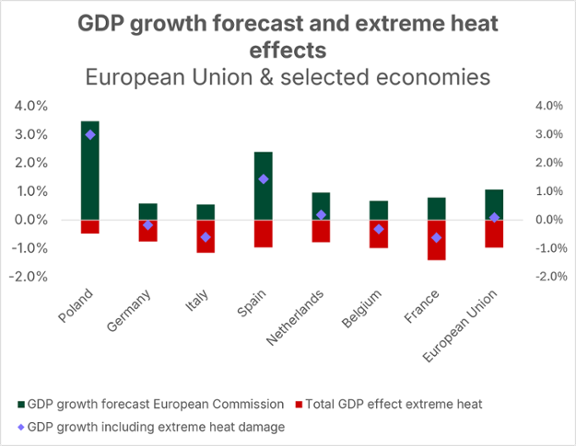
The estimated average EU-impact masks large differences between countries. We estimate that France will suffer the largest economic impact of extreme heat this year. A large jump in hot days relative to what its workforce and infrastructure are used to, combined with only moderate acclimatisation and below-average air-conditioning penetration mean that France could see its GDP growth reduced by 1.4 percentage points due to extreme heat. Since the GDP forecast for France was quite low to begin with, this could well result in economic contraction for France of about -0.6% in 2026 compared to last year. Poland, on the other end of the spectrum, is forecasted to have only a few more hot days than usual. Some of the EU-wide transport and energy effects of the extreme heat will still spillover to the Polish economy but, in combination with its already high GDP-growth forecast, we still expect about 2.9% economic growth this year. The Netherlands can expect about 0.8 percentage points of GDP growth loss due to extreme heat this year. Combined with the pre-existing 1% forecasted GDP growth, this leaves the economy in 2026 about stagnant.
Policies
Some of the discussed damage can be reduced through adaptation: shifting crop varieties and planting windows, expanding irrigation, insulating buildings, shifting working hours and expanding air conditioning. Such measures are costly and cannot prevent all harm, but they are increasingly necessary, especially for people exposed to severe heat stress. Access to protection is also deeply unequal. Wealthier households can afford insulation, cooling systems and higher energy bills, while low-income households are more likely to live in poorly insulated homes and may be unable to keep them cool. With El Niño coming up and the structural trend of hotter summers, adaptation must therefore not address only heat, but also the inequality in people’s ability to escape it.
Indeed, the evidence suggests adaptation helps, but is only partial. One modelled European estimate suggests adaptation could cut labour-productivity losses by around 40%, but not eliminate them. Each measure also carries its own cost or trade-off: more air conditioning raises electricity demand at exactly the moments supply is most constrained, which is part of the reason why energy matters as much as it does.
Adaptation alone is not enough. The long-run literature is unambiguously concludes that further warming raises damages, and does so non-linearly. So, the more durable answer sits upstream: urgent and forceful mitigation of the emissions that make summers like this one more frequent and more intense. Adaptation lowers the bill somewhat at any given level of warming, but it cannot substitute for limiting that warming in the first place.
Mitigation cannot rely on technological substitution alone. A recent IMF working paper documents that, historically, global consumption of every major energy source and material has risen in absolute terms even as the carbon and energy intensity of the world economy has fallen, what the authors term the "Generalized Jevons Paradox": efficiency gains and the deployment of low-carbon technologies have tended to coincide with rising, not falling, total energy and material use, rather than substituting for fossil fuels outright. This matters for how mitigation policy is designed: carbon pricing and technology subsidies, the standard toolkit, work by changing relative prices between "clean" and "dirty" energy, but the evidence suggests these two are complements more than substitutes at a global scale. The implication is that mitigation needs a demand-side complement, policies that manage and moderate total energy and material demand directly, alongside supply-side decarbonisation. This contrasts with policies which implicitly and falsely assume that that technical efficiency gains will automatically be translated into lower aggregate use, ignoring that demand grows as efficiency rises.
A pattern, not a coincidence
Something should have happened by now. A summer this hot, this visible, this costly, ought to have been the moment the abstraction ends. Instead of modeling what climate damages in the distant future might mean, we are seeing huge areas burn while power plants are being shut down in response to a lack of water. This ought to be the kind of shock that makes people, and the institutions that represent them, move.
It did not happen yet. On 17 July, around the time the EFFIS was logging record hectares burned and health ministries were counting their dead, the European Commission tabled a weakening of the EU's main carbon-pricing instrument, easing the trajectory of the emissions cap through the 2030s. The stated reason was competitiveness.
This is a pattern worth noting: climate damage slows the economy; the political response is to loosen the very policy meant to prevent that damage, in the name of protecting growth; emissions and exposureboth rise as a result; and the next heatwave, on a hotter baseline, costs more. Let’s call this what it is: a doom loop. Not because anyone denies this summer happened, the data we use in this paper are not seriously contested, but because the economic logic that produced today’s climate change is treated as sacrosanct even as the damage it produces becomes undeniable.
Europe still has some room to break that loop; the arithmetic in this paper is not yet catastrophic, an economy running at 1.1% growth losing another 1.1% is bruising, but it still exists. But these bruises accumulate and will accelerate if we don’t take action. Every year adaptation without mitigation is a year borrowed against a hotter baseline, and every policy loosened to protect this year's growth number is a subsidy paid by whoever is facing the next heatwave. The choice facing Europeans and their policymakers is not whether to pay for a summer like this one: the damage is already here. The choice we have is to keep subscribing to ever more costly summers, by continuing to delay our efforts to mitigate climate change, or to start treating climate change like the (literally) burning emergency it presents to our wellbeing and our economies.