
Europe is currently facing wildfires, heatwaves and the high costs of fossil dependence. And now, the European Commission has proposed changes to the EU Emissions Trading System (ETS) to align it with the 2040 climate target.
Some ideas are useful. But most of the proposed changes make the system weaker. If Europe wants investments to flow into clean technology and reduce fossil independence, it needs an ETS that is strong, credible and predictable.

In April we already argued that a credible carbon price is one of Europe’s strongest tools to help industry change. If the ETS is weakened, frontrunners lose the investment certainty they need and face unfair competition.
For 20 years, the ETS has cut emissions, driven innovation and contributed to cleaner air. It also has generated billions in public revenue. It works by putting a price on emissions and a cap that falls over time. That combination of a falling cap and increasing carbon price gives companies a reason to invest now rather than wait. Currently, the ETS is starting to affect those that have been slow to invest in clean technology and fossil independence. Four of the proposed changes will reward these laggards. Still not everything in the package is bad.
Four changes that risk less investment in clean technology and more emissions
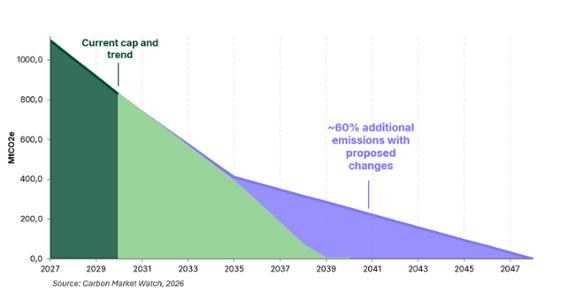
The first change is a slower decline in the emissions cap. Setting the annual reduction to 3.7% for 2031–2035 and to 1.7% from 2036 (see figure 1). That might not sound like big changes, but the effect is significant and means a much longer dependence on fossil fuels. It also puts the 2040 climate target at risk. The ETS originally was planned to stop issuing new allowances around 2039. Under this proposal, it keeps issuing them until roughly 2046 to 2048. That means a permanent increase in the total amount of pollution the system would allow. It is estimated to add 2 billion tonnes of extra emissions, that’s equivalent to the combined yearly emissions of France, Germany, Italy, Spain and Poland.
Another change to resist is the four-year extension of free rights. The ETS started with lots of cushioning, including free emission rights to industries such as steel, cement, fertiliser producers, and aluminium. To make sure companies would invest in industrial decarbonisation, these free rights were set to be phased out by 2034. The proposal now pushes that date back to 2038. This punishes companies that already invested in clean technologies.
Under the proposal, companies that submit a decarbonisation plan receive 80% of each five-year allocation paid up front. The final 20% is only released once the investment is verified. That conditionality is a genuine improvement. But a plan submitted today and an investment verified four years later leaves a long window in which a company can hold free allowances while doing very little. We believe it would be better if a significantly larger share should only be released once the investment in clean technology happen. And most importantly: the phase-out timeline should not move for it.
The Market Stability Reserve is also being weakened. This mechanism removes or releases allowances from the market to keep the carbon price stable. Under the proposal, the rate at which it removes surplus allowances halves from 24% to 12%, and the mechanism that cancels allowances above 400 million in the reserve is removed. Both changes make oversupply more likely. That matters because oversupply was an issue in the ETS's early years: it pushed the carbon price down, reducing the incentive to invest in clean technology. Reintroducing that risk is enough to unsettle the long-term price expectations that investment decisions rely on.
From 2036, the EU could also meet part of its climate target using international carbon credits, up to 5% of 1990 emissions. That limit is already fixed in the Climate Law, so the real fight is not the volume, it is the quality bar for what counts as a credible credit once the detail is written later this year.
Two ideas worth backing
Not everything in the proposal is negative. The new Industrial Decarbonisation Bank addresses can a real gap: only around 5% of the ETS revenue has reached the industry that it covers. Another useful step is the rule that requires member states to spend half of their national ETS revenues on industrial decarbonisation. Together this can help more investments to flow to clean technology and reduced fossil dependence across all of Europe. Looking ahead, the Bank, or a successor body, could take on a more active role: guiding an optimal CO2 price path, the way a central bank manages an inflation target.
Another important step is the Electrification Action Plan, published on 17 July 2026 alongside the ETS review. For the ETS to work well, governments need to create need to create the right conditions. That means reducing the price gap between electricity and fossil energy costs by phasing-out fossil subsidies and speeding up grid deployment.
There is still time to push back
These proposed changes are not a law yet. Parliament and Council will now negotiate, with agreement targeted for early 2027.
The businesses and investors who built their plans around a carbon price that keeps rising are still the quiet majority in this debate. A strong ETS with a credible and predictable carbon price is crucial to mobilise private capital to flow to clean technology.
Now is the time join forces and speak up before these changes becomes permanent.