
- Critical raw materials are essential for the energy transition, but new mining is not the only way to secure supply.
- The EU's Critical Raw Materials Act accelerates investment in extraction without requiring lower-impact alternatives to be explored first.
- A new Material Sourcing Hierarchy would make virgin mining a last resort, after demand reduction, substitution and material recovery.
I. Context: Resource demand, waste abundance, and the financial cost of extraction
The energy transition requires substantial quantities of critical raw materials (CRMs), like lithium, cobalt, nickel and rare earth elements. This growing demand has been used to justify an expansion of mining in the EU. However, the situation is more complex than the extractive narrative would suggest.
The International Energy Agency’s estimates that USD 500–600 billion in mining investment may be required by 2040 to meet energy-system demand. At the same time, across the European Union, large quantities of critical metals already exist in end-of-life products (urban stocks), industrial residues, as well as in mining waste and tailings. European research initiatives have documented considerable secondary resource potential within Member States. While technical feasibility and economic viability vary across contexts, these findings challenge the presumption that new extraction is the only pathway to material security.

Before the first dig: a gap in how sourcing decisions are structured
We've known for a long time that it's better to prevent environmental harm than just clean it up afterwards. For example, the environmental mitigation hierarchy (avoid, minimise, restore, offset) structures impact assessments by prioritising preventive measures. It draws from conservation biology’s “no net loss” framework and was formalised in the Performance Standard 6. Interestingly, big mining and energy companies (including Rio Tinto helped bring the mitigation hierarchy into practice back in the early 2000s. So, this sequencing logic wasn't imposed on them from the outside, they helped shape it.
Today, the mitigation hierarchy is a standard feature of environmental impact assessments across jurisdictions. However, it is subject to plenty of criticism, especially that, it is not always applied correctly, and that monitoring is frequently flawed. But there is a more fundamental issue when applying the mitigation hierarchy to resource extraction: the hierarchy provides no incentive to avoid virgin mining all together, and consider alternative sourcing practices. Instead, the ‘avoid’ aspect of the hierarchy refers only to limiting creation of negative impacts, most often by not placing projects in key conservation areas.
Approaches that share a common logic to the mitigation hierarchy are the EU’s waste hierarchy and the circular economy r-ladder. In these hierarchies lower-impact interventions must be considered before higher-impact ones are authorised. You can apply these hierarchies to mining and materials use. But none of them were designed to answer the fundamental question of whether we should dig in the first place. As a result, they do not prevent unnecessary extraction, but instead only structure decisions after extraction is already assumed. A new framework is therefore needed that operates before extraction decisions are made.
The Critical Raw Material Act locks in virgin extraction
The CRMA is key for resource governance within the EU. It’s Article 6 states that a project may be recognised as a “Strategic Project” where it meaningfully contributes to the security of supply of strategic raw materials and is implemented sustainably. When digging deeper into the regulation, we see that the intention is for Strategic Projects to “benefit from streamlined and predictable permitting procedures and support in gaining access to finance.” We see more of this in Article 17, which requires the Commission to set up a system to facilitate offtake agreements for strategic projects. In practice, such coordinated support functions as an industrial policy instrument. By improving financing conditions, reducing market uncertainty, and pre-arranging demand through off-take agreements, the regulation lowers the upfront cost of mining projects and makes them easier to finance. This is precisely the kind of policy that is missing for circular companies, to incentivise alternative, less-intensive material sourcing.
Mining investments shape long-term industrial pathways because projects involve large sunk costs, stranded assets and decades-long lifespans. As a result, once capital is committed, downstream industries tend to adapt the materials that are being supplied. Technology, infrastructure, and business models begin to align with this material base, making harder to switch to better alternatives. This process is referred to as becoming “locked-in“.
Instead of requiring actors to exhaust lower-impact sourcing options before accessing public support for virgin extraction, the CRMA enables accelerated investment in extraction. The result is a continuation of capital flowing toward projects labelled strategic rather than toward projects demonstrating the lowest environmental burden.
II. A proposal: the material sourcing hierarchy
The Material Sourcing Hierarchy is based on the principle that virgin extraction is justified only after demonstrable exhaustion of lower-impact material provisioning pathways.
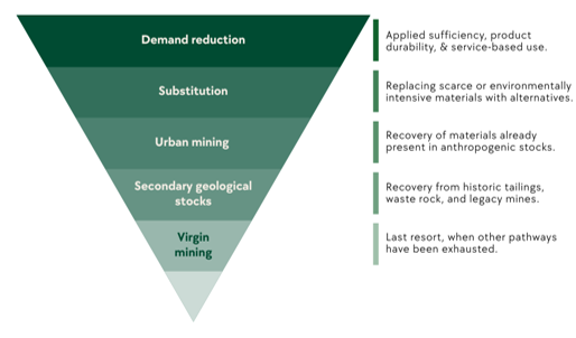
Demand reduction - At the very top of the hierarchy's five tiers is demand reduction. Reduction is needed because ‘sustainable mining’is a contradicting term so long as consumption continues to rise. Estimates show that the primary resources extracted annually linked to economic growth are roughly four times the resources saved by circular economy initiatives. All while global materials use is projected to double by 2050. Most mined metals and minerals are used in steelmaking, construction and chemical manufacturing, where demand is driven by infrastructure development and urbanisation. Demand reduction in these sectors may mean designing batteries with lower material intensity, extending product lifetimes, or avoiding unnecessary duplication of material stocks by utilising product-as-a-service business models.
Substitution - Where demand cannot reasonably be reduced further, the next level of action is substitution. Substitution seeks to replace scarce or environmentally intensive materials with alternatives. An example is the development of sodium-ion battery chemistries as a partial alternative to lithium-ion systems. While sodium-ion batteries are currently able to store less energy, they offer advantages in material availability and cost stability. Serious investment in substitution has the potential to counter the argument that all critical materials are irreplaceable and therefore justify accelerated extraction.
Urban mining & anthropogenic stocks – Next, the recovery of materials already present within the economy. This is referred to as urban mining from anthropogenic resource stocks. Modern cities and waste streams hold vast quantities of embedded metals in end-of-life electronics, vehicles, buildings, and industrial residues. Recovering lithium from electric vehicle batteries or extracting rare earth elements from discarded wind turbine components are great examples within this tier. It’s important to note that urban mining does not entirely eliminate the environmental impacts of material supply as many of these recovery processes use a lot of energy and have other lifecycle impacts, but they do avoid the land disruption and biodiversity loss caused by opening new mines.
Secondary geological stocks - After we've tapped urban mines, we can look at old mining waste. These consist of historic tailings, waste rock, and legacy mining deposits that were previously uneconomical to process. The reopening of previously closed mines in resource-rich countries such as Canada and Australia presents a less environmentally destructive alternative to virgin mining. Advances in technology and commodity prices now make such sites viable sources of supply. Policymakers and investors could prioritize evaluating these sites before considering riskier alternatives, such as deep-sea mining or asteroid mining.
Virgin mining - This tier involves the development of new geological extraction sites. It is crucial when virgin mining is the only viable route, that operations prioritize minimizing environmental impacts and emphasize the regeneration of the land post-mining. Methods can include small-scale, eco-certified, and energy-conservative mining projects on land.
From the perspective of the proposed hierarchy, virgin extraction is not inherently illegitimate. However, applying the hierarchy forces it to be a residual option.
Turning policy into action
Translating the Material Sourcing Hierarchy from principle into practice requires clarifying how and at what governance levels such a hierarchy could be governed.
At the EU level, it could be embedded within the sustainability criteria of Article 6 of the CRMA, ensuring assessments routinely consider alternative sourcing pathways. According to the CRMA’s own objectives what is needed for the EU to secure sustainable supply are diversified sourcing, technological progress and resource efficiency. The material sourcing hierarchy is a potential lever for improving all three. Combined with circular economy objectives like eco-design and minimum recycled content requirements, it could strengthen CRM supply chain resilience.
At the member state level, firms could demonstrate compliance via minimum capital allocation or credit systems. Companies might dedicate a fixed percentage of budgets to higher-tier strategies before new mining permits are granted. For instance, prior to being granted a permit a firm could be obliged to source 20% of lithium supply from recycled batteries, or demonstrate active investment in substitution research. This could be part of a sustainability assessment that precedes existing environmental impact assessments.
Investor criteria can reinforce the hierarchy. Projects that bypass higher-tier sourcing (proceeding directly to virgin extraction) should be treated as higher-risk investments. This is because such projects carry greater exposure to litigation, regulatory challenge, or reputational harm, as well as the potential for stranded assets if future policy or technological developments render the extraction unnecessary or unsustainable.
By explicitly recognising hierarchy-aligned sourcing as a material risk indicator, investors and financiers could incorporate compliance with the hierarchy into their due diligence processes. Investment portfolios could be assessed against EU-level benchmarks (such as the CRMA’s 2030 targets). For example, if a battery producer can demonstrate that it sources 10% of material supply from domestic extraction, 40% from domestic processing, and 15% from recycling it is evaluated as lower risk. On the other hand, firms failing to demonstrate progress through the hierarchy could face higher financing costs and limited access to capital.
Governing demand, and extending it to sourcing decisions
If material demand is treated as fixed, extraction will always appear necessary simply because consumption projections are high. However, EU law increasingly regulates the structure and intensity of demand through instruments such as the Ecodesign framework, recycled content requirements, and durability standards. This demonstrates that EU institutions have begun to see material demand as a legally governable variable.
Evidence of this conceptual shift appears across EU instruments like the EU Climate Law and the Energy Efficiency directive, however, it is most evident in the Ecodesign for Sustainable Products Regulation. This regulation intervenes most directly in product-level material intensity, empowering the Commission to set requirements on durability, reparability, recyclability and resource efficiency. Similarly, the Battery Regulation integrates circularity across the battery supply chain by mandating minimum recycled content and durability requirements. If products last longer, are easier to repair, or are designed for disassembly, the demand for virgin materials in a system declines over time. The Commission is already ready to govern demand, the material sourcing hierarchy simply extends this upstream.
Conclusion
The CRMA advances virgin mining by speeding up permits, easing financing, and arranging off-take deals. Meanwhile, circular and recycled sourcing pathways get less support. Without a system to evaluate alternatives, the CRMA may lock us further into relying on primary extraction.
The Material Sourcing Hierarchy offers a solution. By ranking sourcing options, it provides a clear way to decide when new mining is justified. Virgin mining becomes a last-resort option, only after higher-tier alternatives have been explored. If the EU wants to balance sustainability with resource security, it must clarify when mining is needed, not just how it is done.